

Overview
This case study was born from a problem I live personally. As a career switcher trying to break into Product Management in Germany, I kept hitting the same wall. There is no clear, structured path to practice the skills that actually get you hired.
I decided to investigate this properly. I conducted problem interviews, synthesized the findings, identified patterns, and built solutions. This is what I found.
The problem space
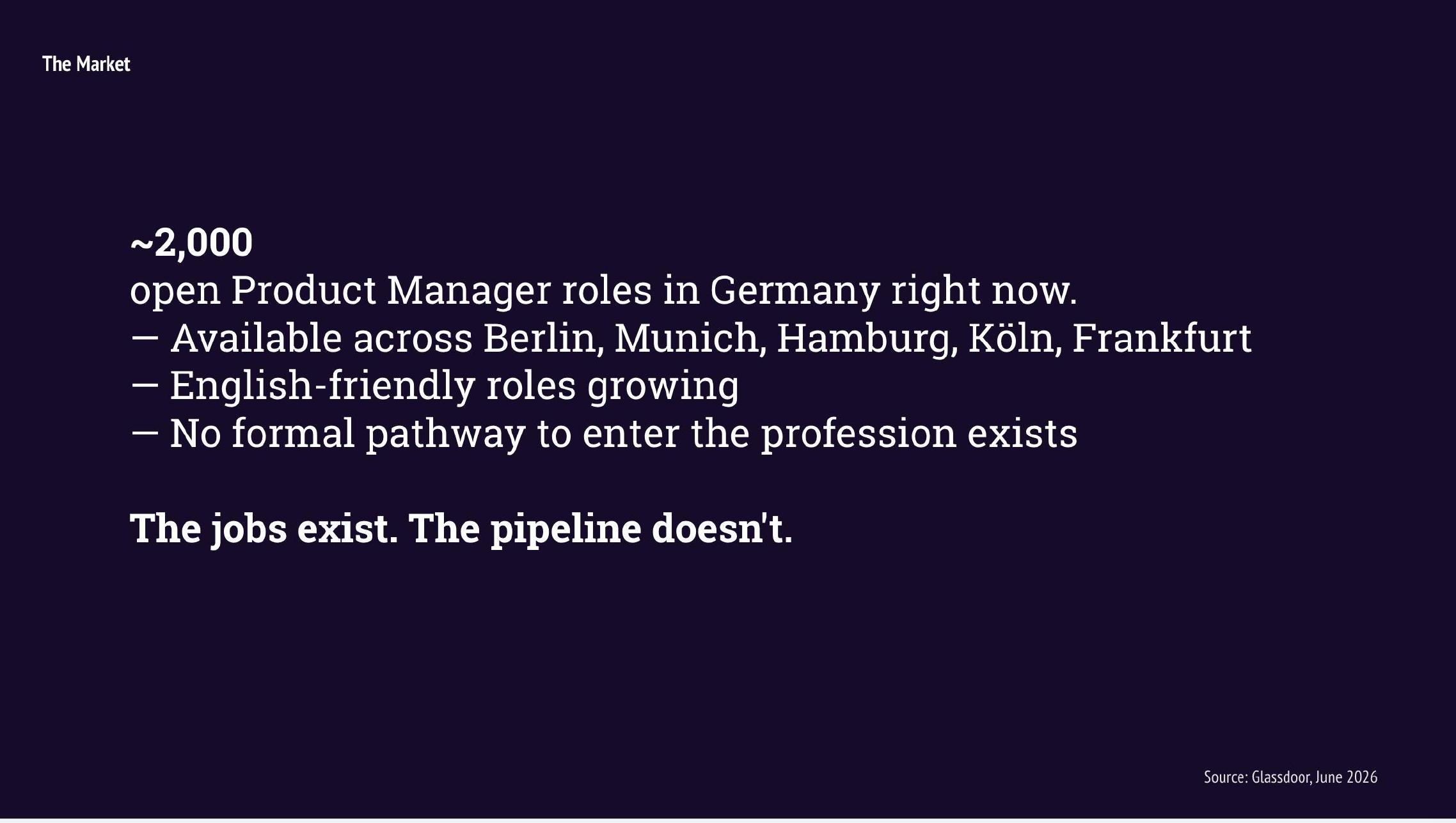
Germany has nearly 2,000 open Product Manager roles right now, across Berlin, Munich, Hamburg, Köln, and Frankfurt. English-friendly roles are growing. The demand is real.
And yet, there is no formal pathway into the profession. No structured entry point for career switchers. The role is largely gatekept: companies prefer hiring people who already have PM experience, creating a catch-22 that locks out qualified, motivated professionals.
The jobs exist. The pipeline doesn't.
The research
Goal: Understand the real barriers people face when trying to develop Product Management skills and break into the role in Germany.
Method: Problem interviews, open-ended, conversational, no rigid script. I wanted people to speak freely about what they were experiencing, not answer a checklist.
Who I talked to:
- 2 in-depth interviews (45–60 minutes each)
- 1 additional perspective from a practicing PM in India
- Supplemented by desk research on PM job market data in Germany
I started each conversation with context, then let the person lead. I listened more than I spoke. I followed threads that felt emotionally charged: those tend to be where the real pain lives.
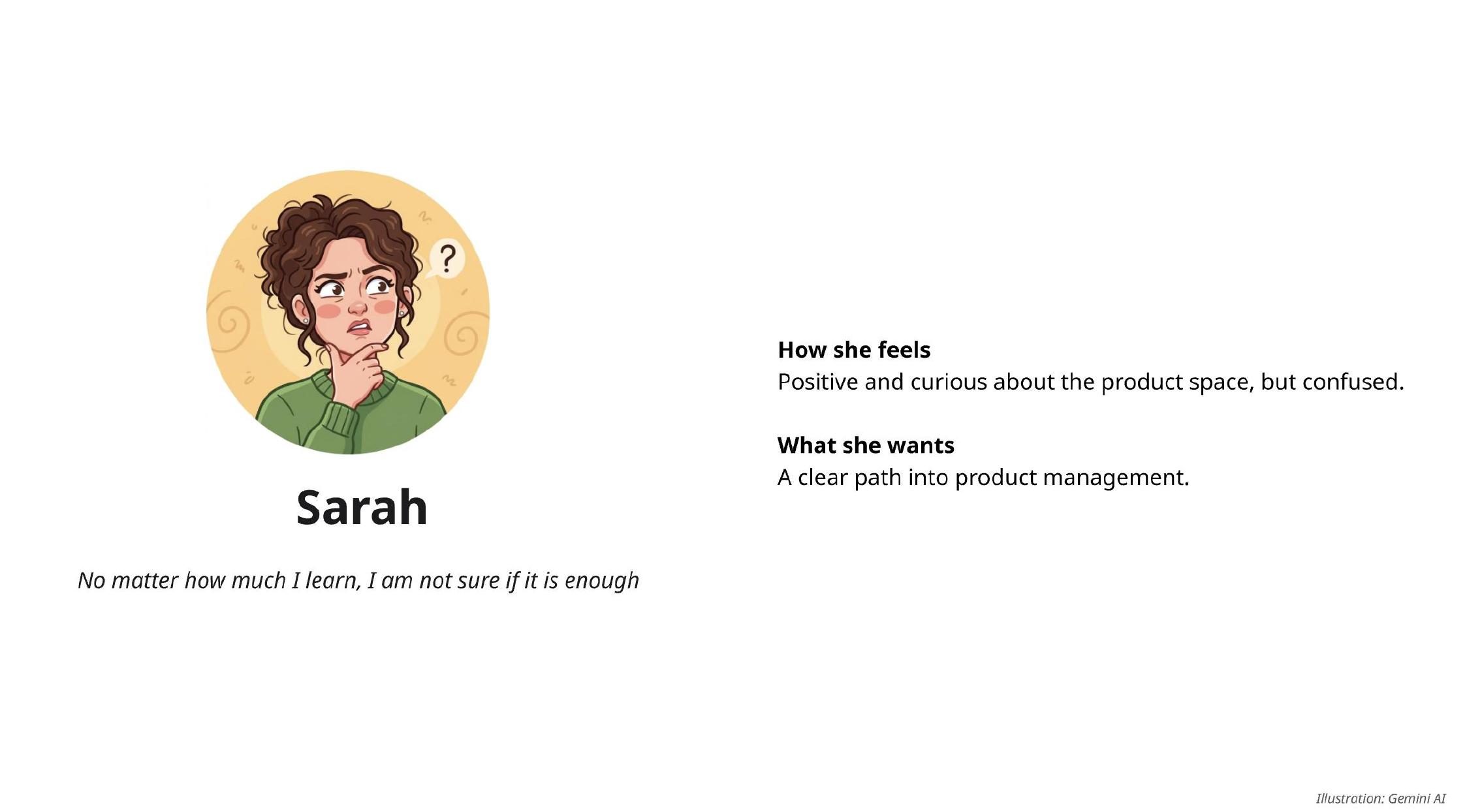
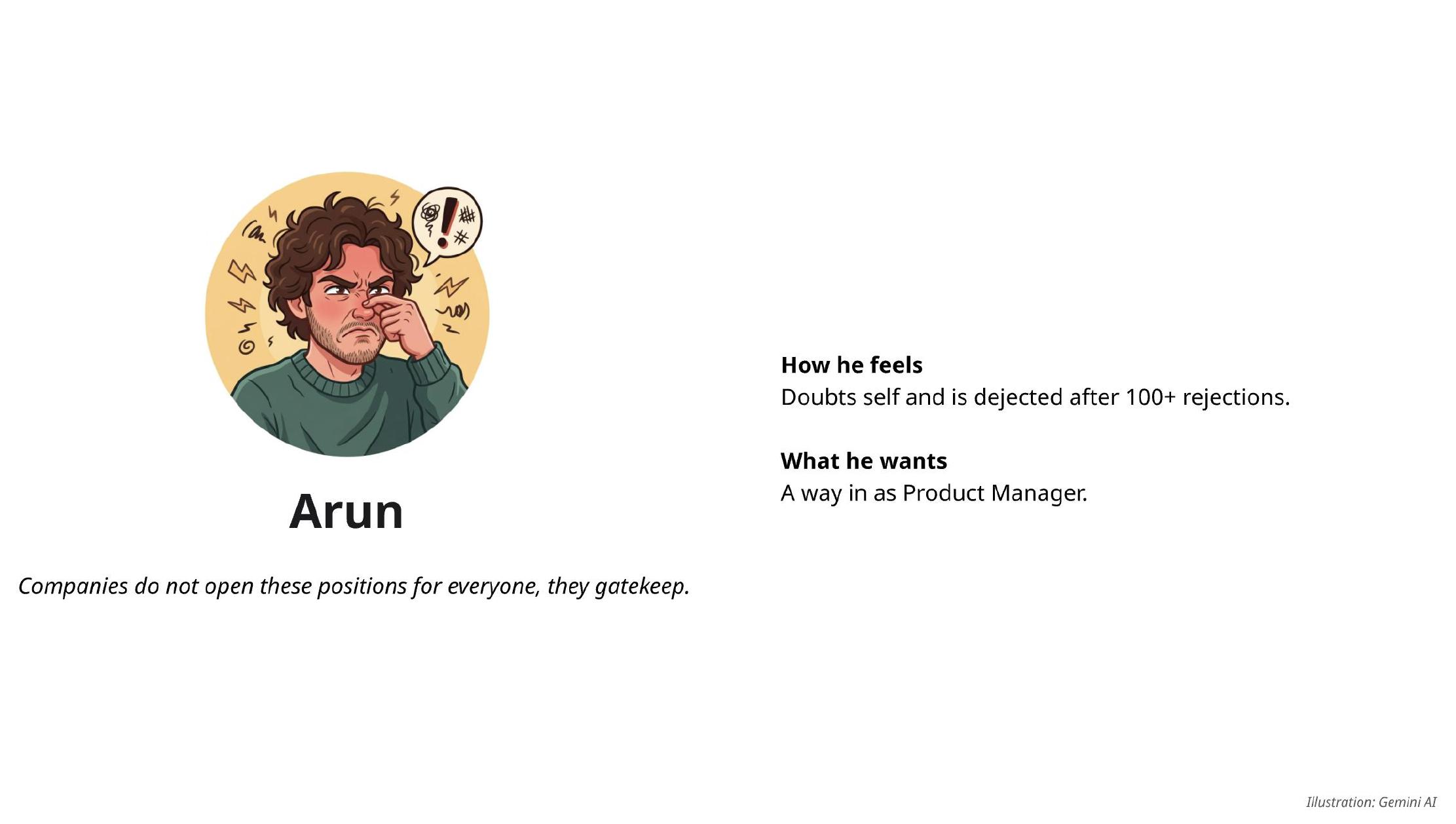
Meet the characters
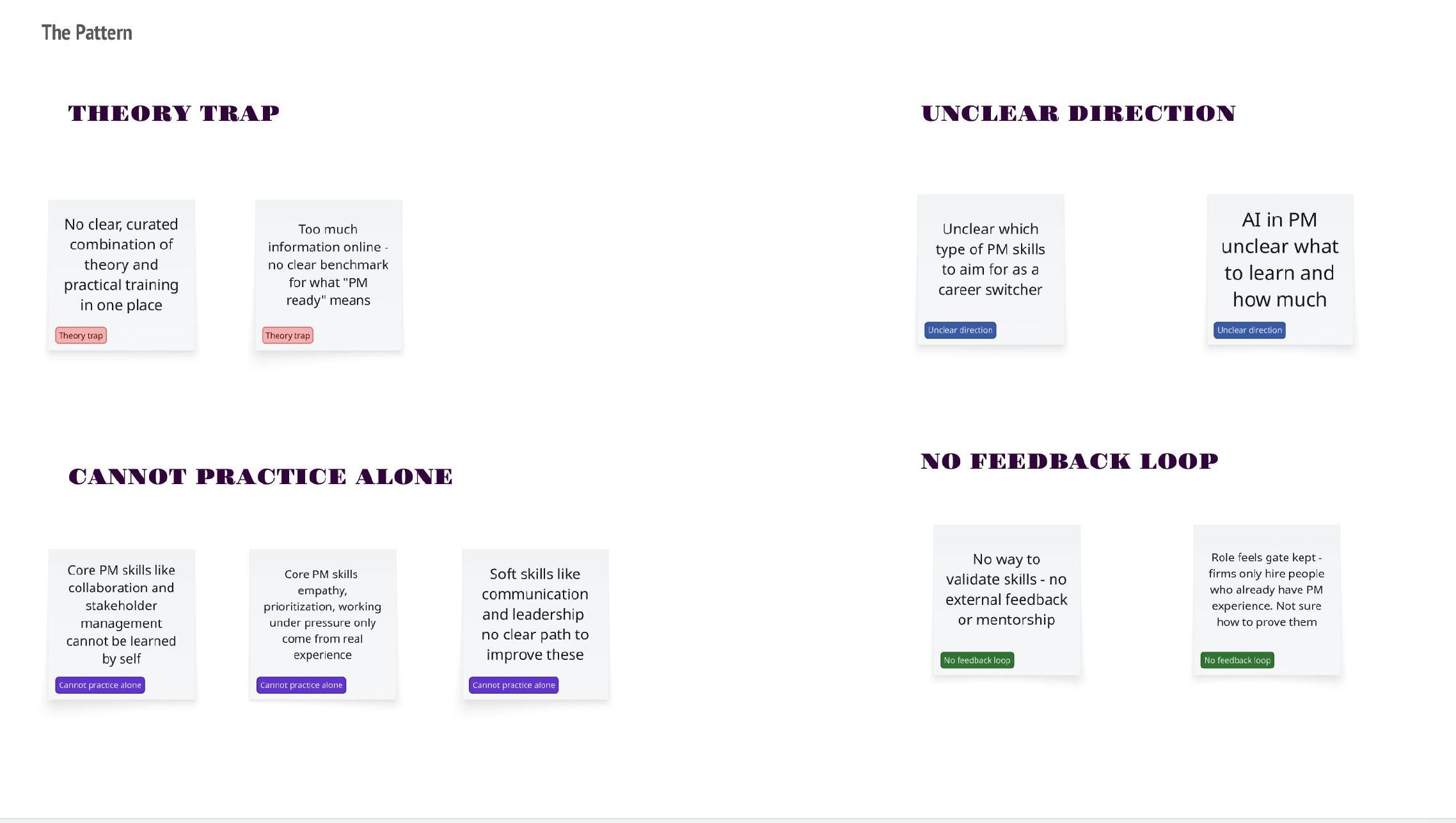
What I heard: the pattern
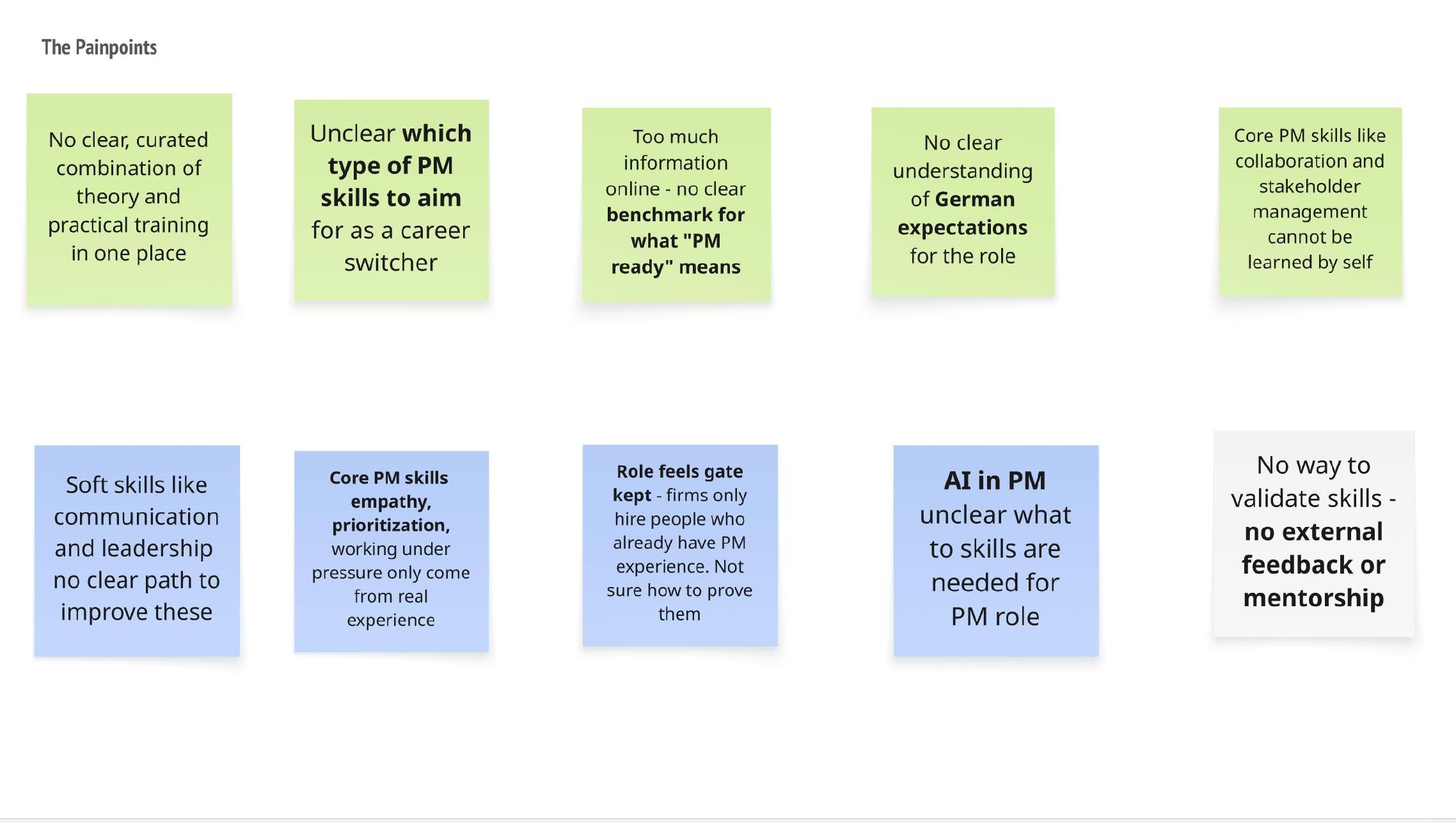
When I listened to Sarah and Arun, the pain points were different on the surface, but underneath, four clear patterns kept emerging.
The insight
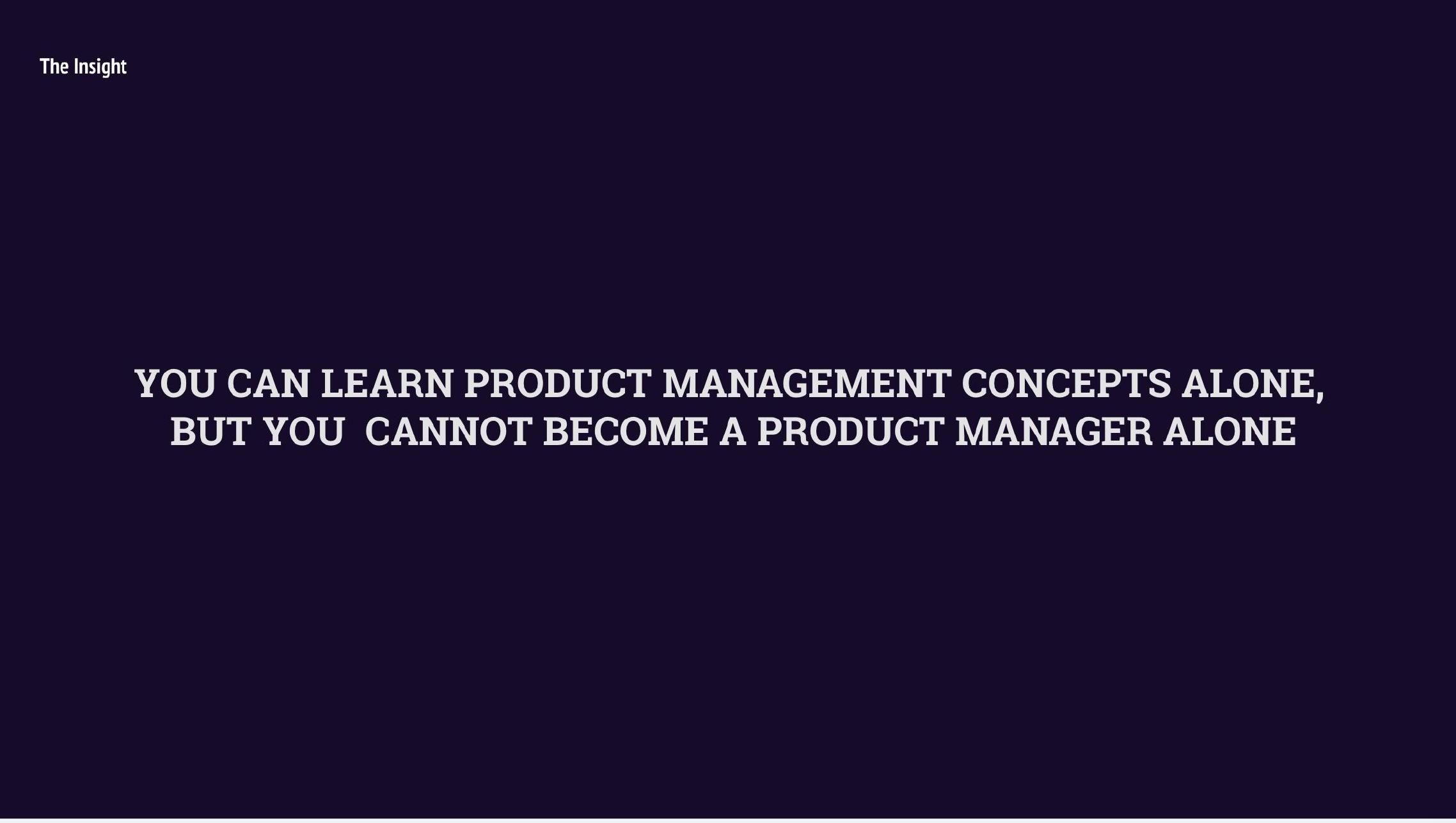
Every course, bootcamp, and YouTube video assumes that learning alone is enough. It is not. And the interviews proved it.
Problem statement
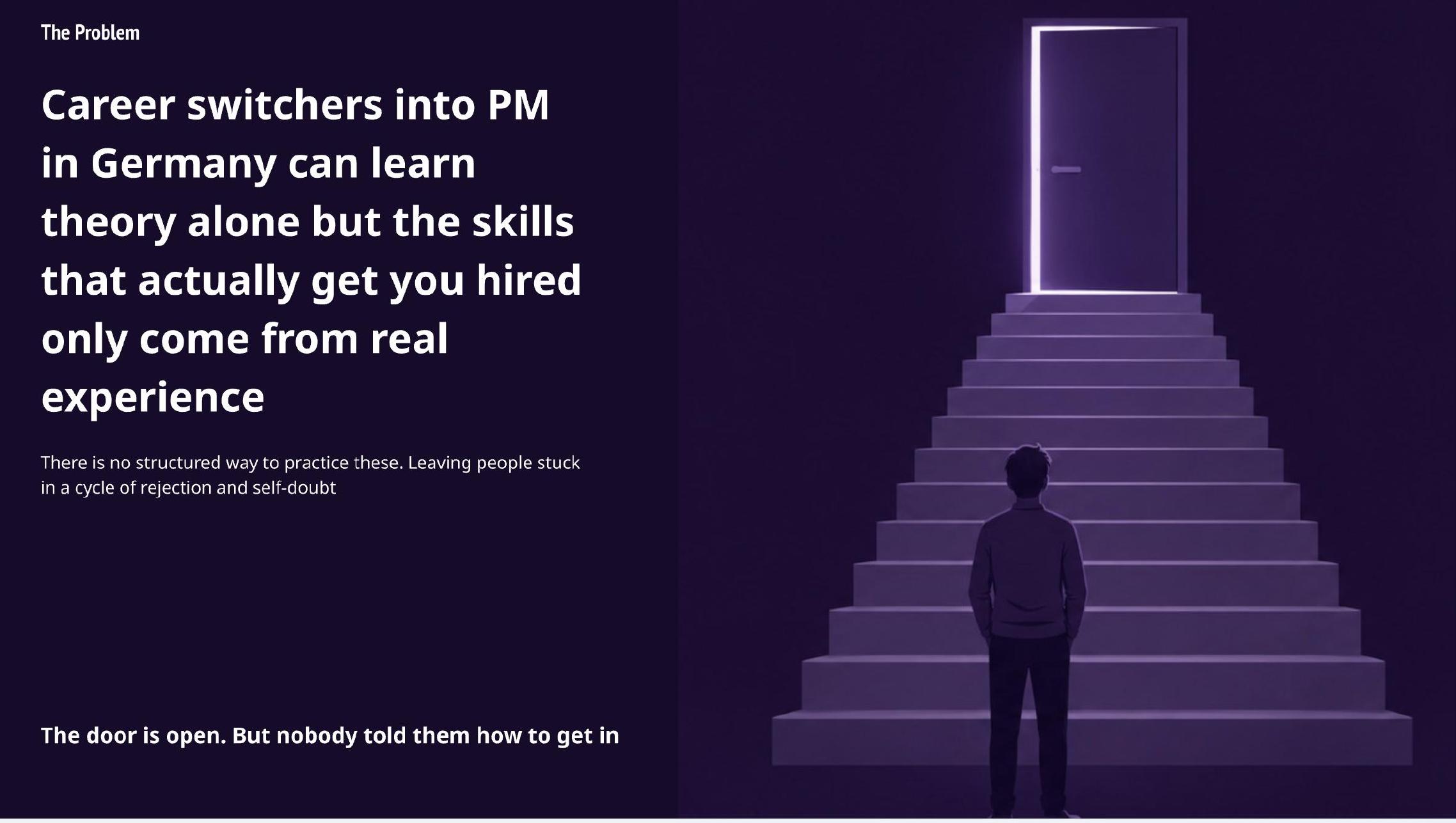
Career switchers into Product Management in Germany can learn theory alone, but the skills that actually get you hired: collaboration, prioritization under pressure, and stakeholder management, only come from real experience. There is no structured way to practice these, leaving people stuck in a cycle of rejection and self-doubt.
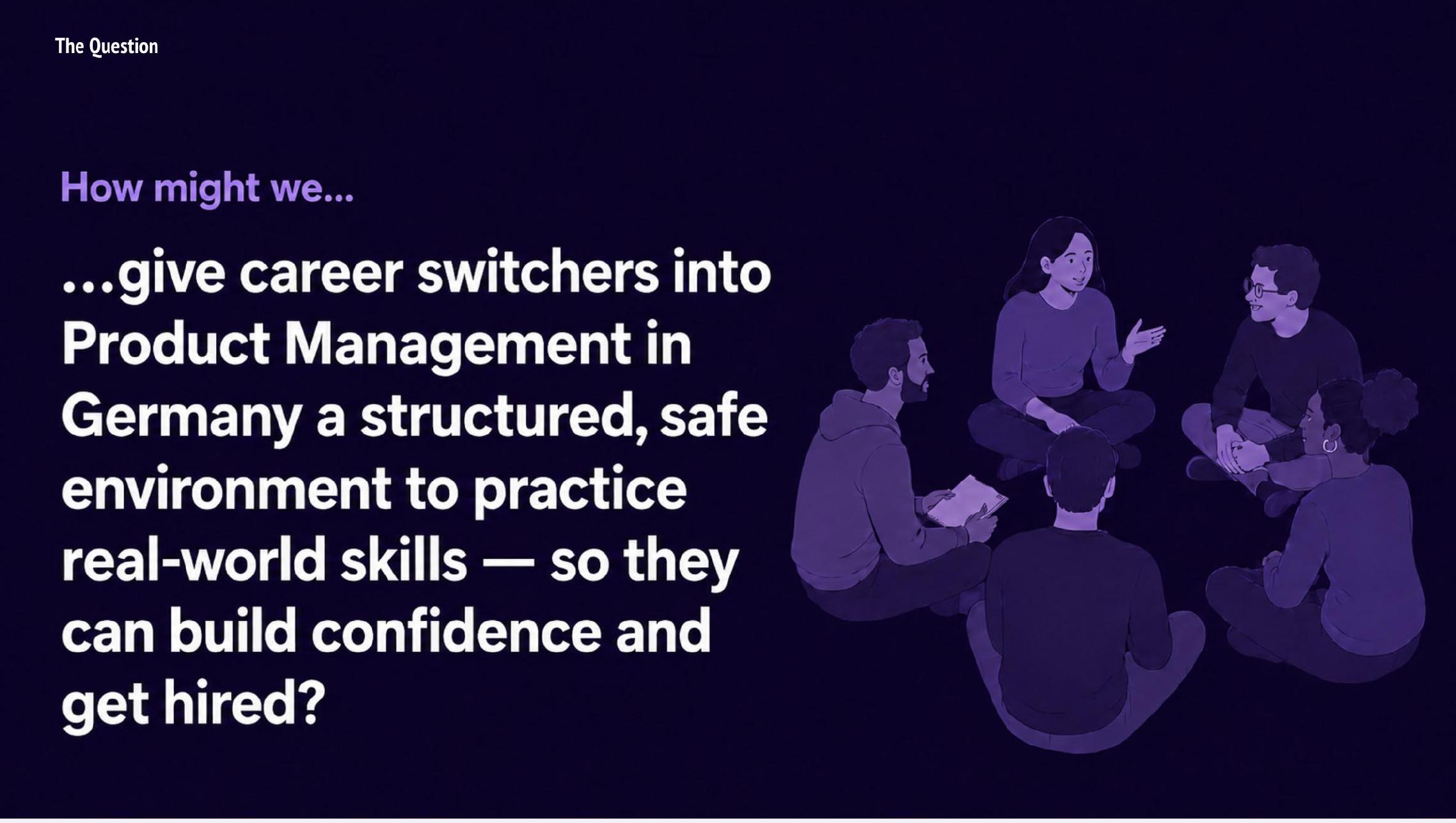
How might we
Solutions considered
| Solution | Impact | Feasibility | Decision |
|---|---|---|---|
| PM Practice Meetups | High | High: start immediately | Selected |
| Duales Studium in PM | Very High | Medium: requires systemic change | Selected |
| Short-term courses at product companies (AfA-sponsored) | High | Low: needs government and company buy-in | Parked |
| Online bootcamps | Medium | High: already exist | Rejected |
Online bootcamps were rejected because they do not solve the people skills gap. That is the core of the problem.
Solution 1: PM Practice Meetups
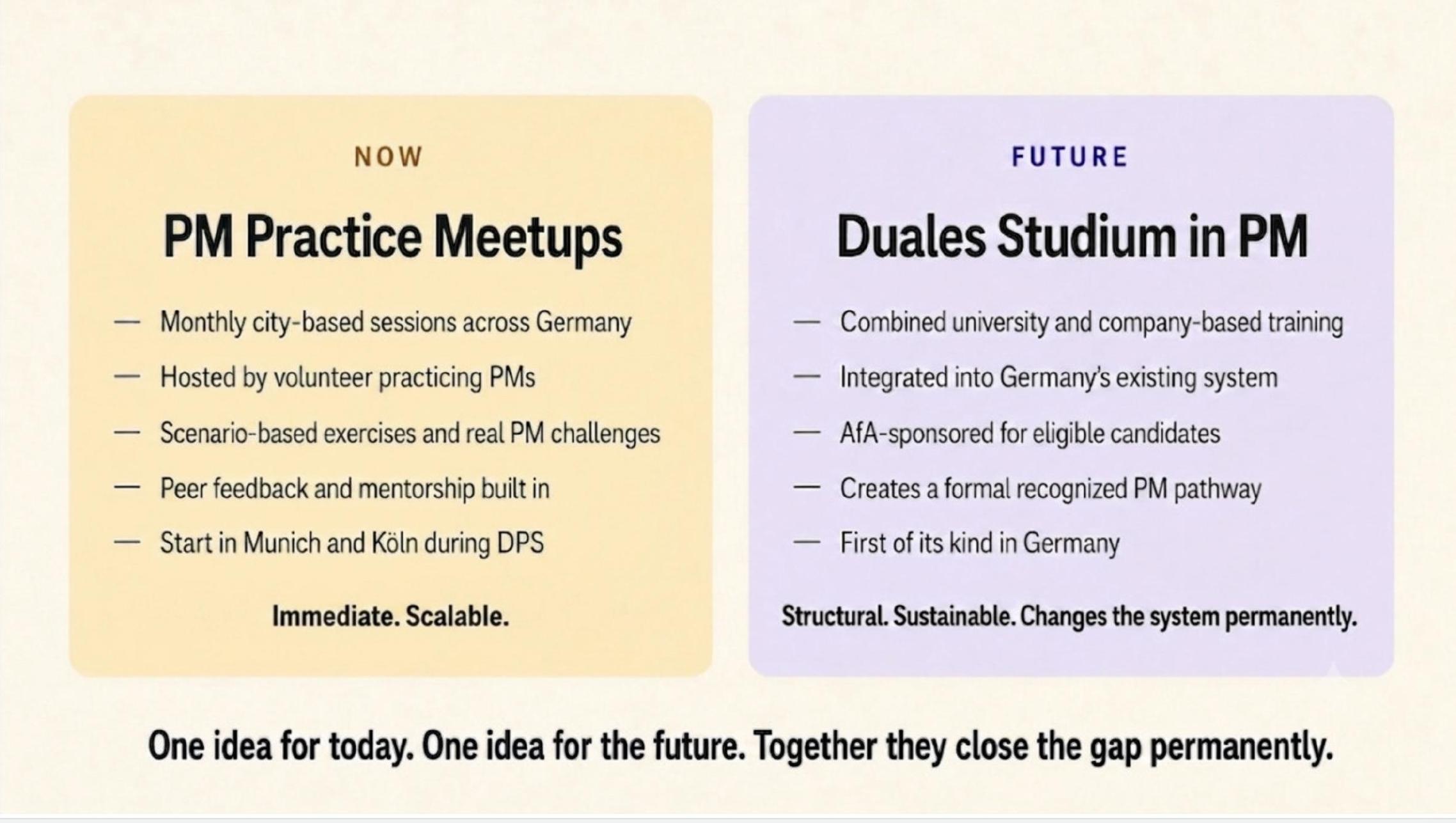
A monthly, city-based meetup network across Germany where career switchers practice real PM skills with experienced product professionals.
Format:
- Monthly sessions in each city
- Hosted by volunteer practicing PMs
- Scenario-based exercises: real product challenges, stakeholder role plays, prioritization under pressure
- Peer feedback and mentorship built in
- Launch in Munich and Köln first, then scale
Why this works: Immediate, can start within weeks. Scalable across any city, volunteer-driven. Fills the exact gap that bootcamps and online courses cannot. Can integrate with existing communities like Product Tank.
Success metric: 20+ consistent attendees across 5 sessions in 2 cities.
Solution 2: Duales Studium in Product Management
A formally recognized Duales Studium programme in Product Management, combining university study with in-company product work, integrated into Germany's existing vocational education system.
Format:
- Combined academic and company-based training
- Students study PM theory and practice it inside a real product company simultaneously
- Sponsored by AfA for eligible candidates
- Creates a formal, recognized PM pathway for the first time in Germany
Why this works: Tackles gatekeeping at its root: graduates have a recognized qualification. Leverages Germany's existing Duales Studium infrastructure. Opens the door for career switchers and German candidates equally. Sustainable through government backing.
What I'd do next
- Validate at scale. Reach a wider audience across Germany, not just my personal network.
- Talk to hiring managers. Understand what actually makes them trust a candidate without a prior PM title.
- Run a pilot meetup. One session, 20 people, measure attendance, engagement, and follow-up outcomes.
- Partner with Product Tank. They already have the community. The missing piece is structured practice sessions.
- Build the metrics framework. Define what success looks like at 3 months, 6 months, 1 year.
What I learned
About the problem: The barrier is not knowledge. It is experience. And experience is structural: you cannot manufacture it alone.
About the process: Letting people talk freely is more valuable than any questionnaire. The most important insights came from following the emotional threads: the frustration, the self-doubt, the resignation. That is where the real problem lives.
About myself as a PM: I am the user. That is both my biggest advantage and my biggest blind spot. I have to keep checking: am I solving my own problem or a shared one? In this case, the interviews confirmed it is shared. But that check has to happen constantly.
Built in June 2026 as part of a product management case study exercise.