The observation
I use Claude and ChatGPT every day for two different purposes. ChatGPT for long language learning sessions. I practice German, get corrected, build on the previous session. Claude for brainstorming, planning, tracking goals. I maintain the same threads for months.
This works well. The context builds daily and I never have to repeat myself.
But frustration exists. I cannot navigate back to earlier concepts or revisit something I missed noting down. I end up scrolling endlessly. Sometimes chunks of conversation just disappear. Just like that. And I have to repeat the context all over again.
I started with a vague feeling: there should be a way to mark something important in a conversation the moment I notice it matters.
The hypothesis
We believe that learners who use LLM agents and maintain long threads for more than 4 hours a week experience the pain of frustration when they cannot navigate to a desired concept. This results in loss of continuity. We will know this is true when we talk to people who use ChatGPT or Claude to learn on a daily basis who can describe a specific moment of frustration.
The landscape: what already exists
Before designing anything, I looked at what had already been tried. The problem exists at three distinct levels.
I also found an open feature request on Anthropic's own GitHub, issue #32874, requesting a pin command for conversations. Filed March 2026. Marked inactive.
Why this is not a memory problem
Every time I raised this problem, people defaulted to memory. Persistent memory will fix it. Model improvement will fix it.
Not everything is a memory problem. This one is not.
Even with perfect persistent memory, you would still have to scroll through a long conversation to find a specific moment. Memory solves what the model knows. It does not solve how you navigate what was said.
And Control F or any other search method cannot fix it either. To search, you need to know exactly what you are looking for. But that is not how learning or thinking works.
Think about a book. As you read, you highlight sentences. Not because you plan to search for them later. Because in that moment, something matters. At the end of the chapter you do not reread everything. You look at what you marked.
That is what is missing in every LLM conversation today.
The validation
I reached out to more than 20 people and asked one question: when a chat gets too long, do you face the scrolling problem?
None of them developers. Consultants, students, a mechanical engineer, an electrical engineer, a medicine student. And my mother.
ChatGPT, Claude, and every other chat agent are not just for tech and IT people. They are for everyone from all possible backgrounds. Because whether we like it or not, LLMs are slowly becoming systems people will learn from, search through, trust and interact with daily. Almost like a second brain. The solution should be just as inclusive.
The solution: Pins
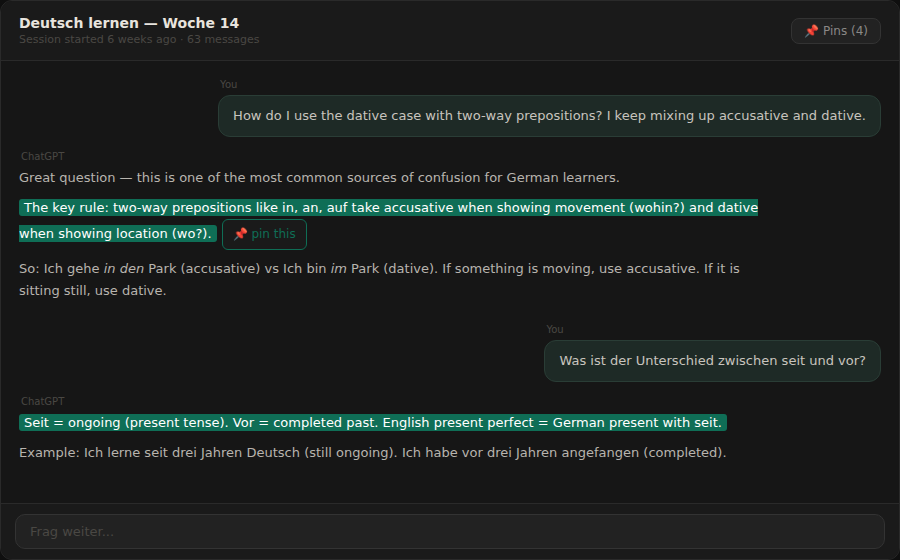
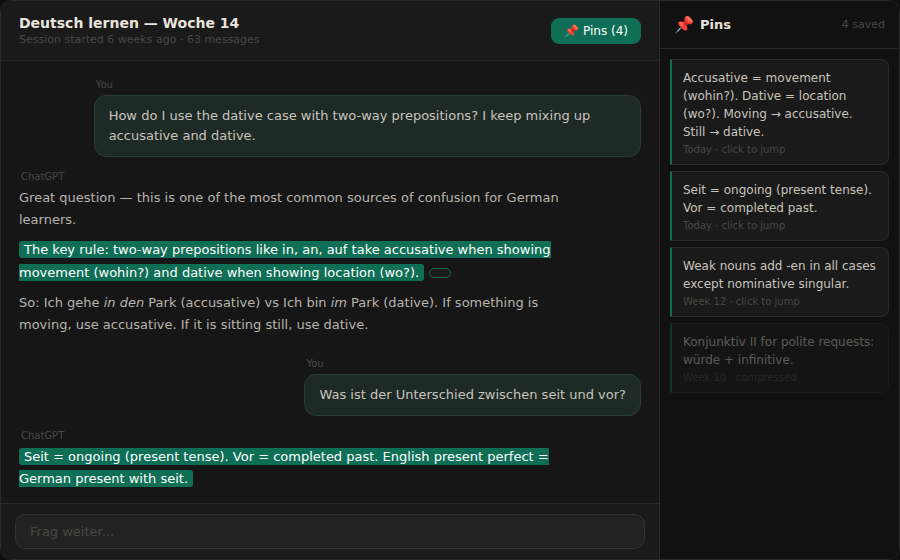
A native marking feature built into the conversation.
The Pins pane is closed by default. One click to open. Slides in from the right on desktop, bottom sheet on mobile. V1 is deliberately simple: one colour, no tags, no folders, no search. Ship and learn.
The wireframe
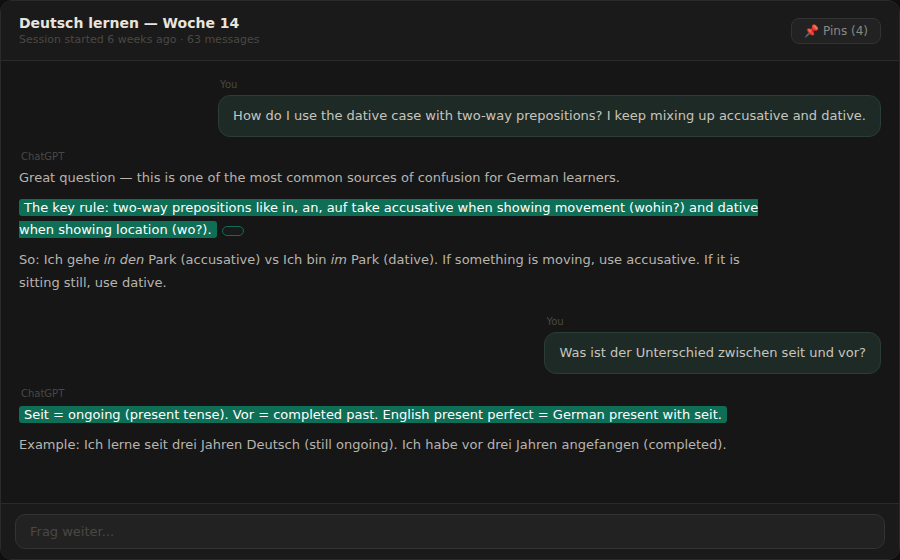
A German learning session. Six weeks. 63 messages. The Pins pane closed by default.
Why this matters
Millions of people outside tech are using LLMs every day. For them it is not just about getting things done. It is about the experience. They immerse themselves in it.
A small UI upgrade would make a huge difference to them.
PS: AI used to edit grammar and shape structure. All observations, research, and the solution are mine.